Your child's rights to basic education in South Africa
We’ve compiled a handy primer to help you understand your rights when it comes to accessing education for your child.
By UCT Online High SchoolPublished 4 min read

Even though education is invaluable, the cost of schooling is a very real burden for many South African parents.
In South Africa, every child has a right to basic education, according to our Bill of Rights. On top of this, our Bill of Rights also says that the state must “through reasonable measures” make education available and accessible.
Basically, what this means is that the law specifies the right of parents to send their children to state (or public) schools without having to pay additional fees if they can’t afford it.
Summary
- What are the different ways to access affordable education?
- “No fee” schools
- Fee exemptions
- What happens if you can’t pay the school fees?
- How to apply for an exemption
What are the different ways to access affordable education?
According to Go Legal, there are a number of different ways for you to access affordable education for your child if you have limited financial resources. This includes “no fee” schools, or receiving some type of exemption.
What is an exemption? An exemption means that you won’t be expected to pay a portion (or the complete amount) of your child’s school fees.
“No fee” schools
The Department of Basic Education (DBE) has categorised a number of schools as “no fee” schools. This means that if your child attends one of these schools, you don’t have to pay school fees (including fees for extra murals).
Make sure to take a look at the DBE’s list of no fee schools for each province in South Africa.
Fee exemptions
For state (or public schools) that charge fees, you can apply for different exemptions depending on the school fee amount and your total income.
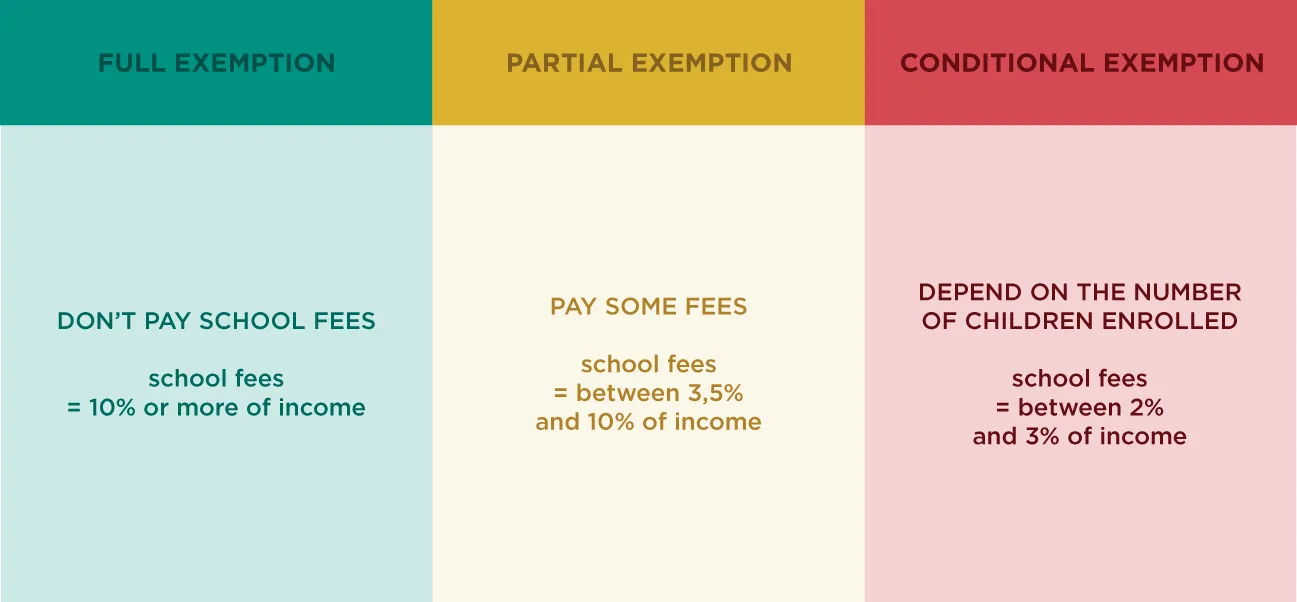
Full exemption: You qualify for a full exemption if the school fees are 10% or more of your total income. A full exemption means that you won’t have to pay any school fees.
Partial exemption: You qualify for a partial exemption if the school fees are between 3,5% and 10% of your total income. A partial exemption means that you’ll only have to pay a certain portion of the fees.
Conditional exemption: You qualify for a conditional exemption if the school fees are between 2% and 3% of your total income. The exemption will depend on the number of your children currently enrolled at public schools.
Also, there are a number of circumstances that mean an automatic exemption should be granted. School fees cannot be charged for:
- an orphaned learner
- a learner who has a foster parent
- a learner placed in a youth care centre or a place of safety
- a learner who has been placed in the care of a family member
- a learner who heads a household or is part of a child-headed household
- parents who receive a social grant on behalf of the same learner (child support grant).
What happens if you can’t pay the school fees?
Parents who find themselves unable to pay school fees need to know that your child can’t be disciplined or excluded from participating in official school programmes. Plus, your child’s school isn’t allowed to withhold their report until fees are paid.
NB: Parents who are: (1) legally responsible for paying fees and (2) who don’t qualify for any of the exemptions discussed here, should know that schools do have the right to sue them for non-payment of fees.
How does the law treat divorced/never married parents when it comes to paying fees?
If you’re not married to the other parent of your child, the school must split the fees between both parents and treat them as individuals when calculating what each parent will pay towards school fees.
Basically this change means that a school can only claim a portion of the fees from each parent. This means that parents can’t be held liable (i.e. expected to pay) for the full amount when they have applied for an exemption.
So, let’s say that each parent is expected to pay R3,000.00 in school fees, but the father hasn’t paid his share. The school isn’t legally allowed to demand the mother pay her R3,000.00 and the other R3,000.00 that’s outstanding.
How to apply for an exemption
You can find out more about the DBE’s exemption process here. Application forms for fee exemptions should be available from the individual public schools. You should contact these individual schools about how to access these forms.
Take a look at our new guide
If you want to learn more about how to figure out what you can afford to spend on your child’s education, we’ve compiled a whole guide to help you calculate the real cost of education.
Please remember that this blog post is provided for informational purposes only, and not for the purpose of providing financial or legal advice.