
Answers to your top questions about high school scholarships
If you’re struggling to find answers to your top questions about high school scholarships, we’ve got you covered.
By UCT Online High SchoolPublished 2 min read

Starting the process of applying for high school scholarships can be overwhelming. You probably have a lot of unanswered questions.
We’ve compiled responses to some of the most common questions about high school scholarships, including:
- Who offers high school scholarships?
- What do scholarships cover?
- When should you apply?
Who offers high school scholarships?
Scholarships are typically offered by corporations, foundations and specific schools.
Corporate scholarships are usually part of the organisation’s corporate social responsibility or corporate social investment (CSI) programme and aim to increase educational access.
Corporations offering high school scholarships include Allan Gray, Investec, KFC and SANRAL.
There are also a number of charitable foundations that provide educational support via scholarships for high school learners.
These include: African Scholars Fund, Kay Mason Foundation, Make a Difference Leadership Foundation, Ruta Sechaba Foundation, and Students for a Better Future Foundation.
Finally, a number of individual schools also run their own scholarship programmes. Unlike corporate or foundation scholarships, school-based scholarship programmes are only for individual schools, and applications must be submitted to each school individually.
What do scholarships cover?
Different scholarships cover different costs, but almost all of them cover some or all of your child’s tuition fees.
They might also cover:
- boarding fees
- stationery
- textbooks
- devices
- uniforms
- support for extracurricular activities.
Some scholarship programmes also provide additional support by providing things like development workshops, private tutoring or extra lessons to scholarship beneficiaries.
For example, SANRAL offers beneficiaries access to psychological counselling, career coaching, extra classes and exam preparation.
When should you apply for high school scholarships?
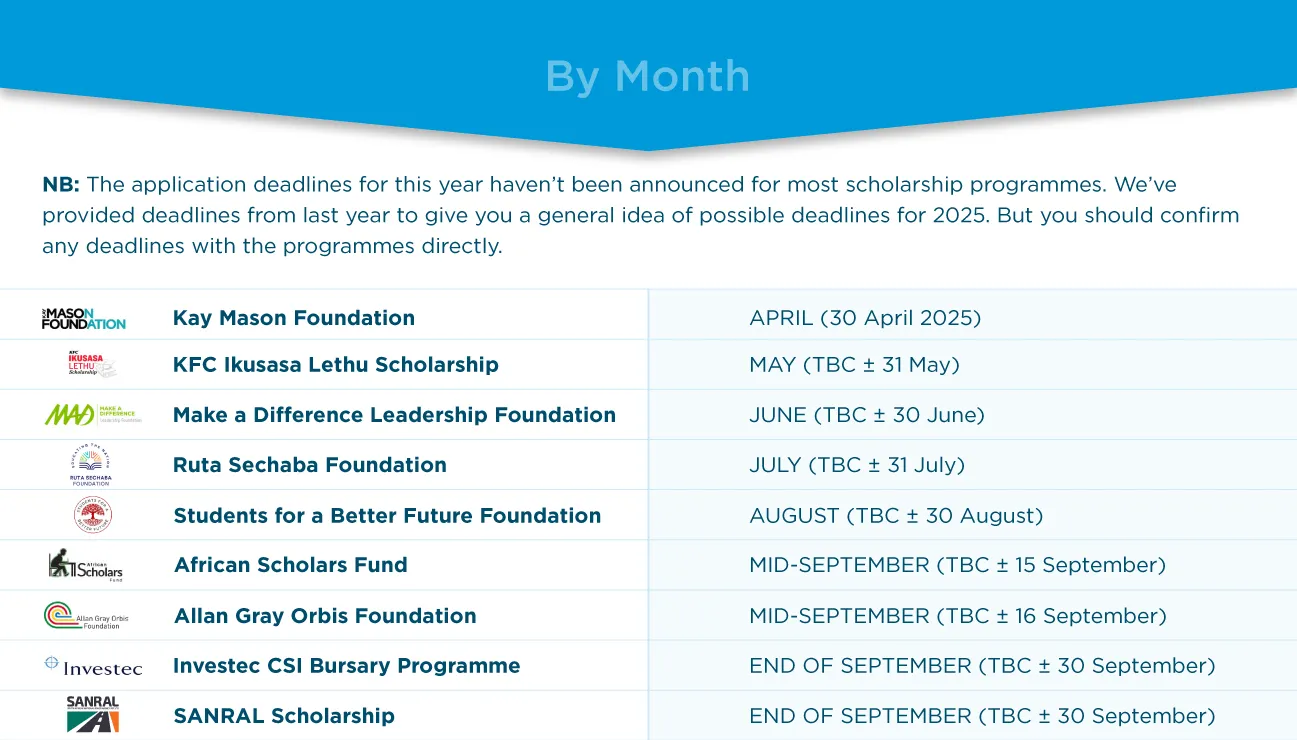
Application deadlines are different for each scholarship programme, but the most important thing to remember is that you’ll need to apply at least a year (sometimes two) before you’ll need the money.
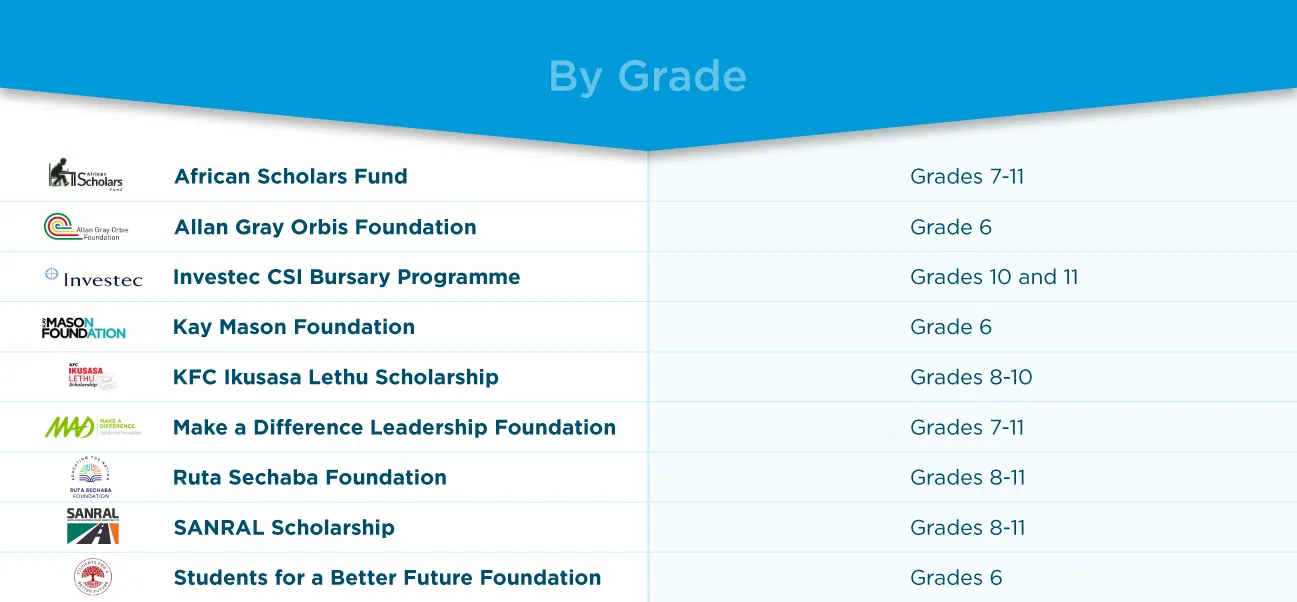
For example, if your child starts high school in 2027, you’ll need to start applying for scholarships in 2026 or even 2025. Most scholarship programmes include the grade of your child as part of the application criteria.
Here’s an overview of when you can apply for each of the scholarships featured in our guide.
To discuss your options for online learning with UCT Online High School, you can reach out to a friendly member of our team.